Ammonium bicarbonate rarely fails because it is “bad quality”; it fails because it was used in a product too thick to let the ammonia escape. At roughly 36–60 °C it decomposes completely into ammonia, carbon dioxide and water vapour, leaving no solid residue and no sodium. That is why it remains irreplaceable for thin, dry, crisp products — crackers, wafers, cream puffs, flatbreads and some traditional fried doughs. Put it into a thick cookie, a moist cake or a closed mould, and you get a lingering ammoniacal odour that no amount of flavouring will fix. The risk is geometry and moisture, not safety.
What is ammonium bicarbonate?
| Item | Detail |
| Name | Ammonium Bicarbonate / Ammonium Hydrogen Carbonate; ; trade names: baker’s ammonia, |
| CAS No. | 1066-33-7 |
| Formula / mol. weight | NH₄HCO₃ / 79.06 |
| Appearance | White crystalline powder or granules; characteristic slight ammonia odour |
| Decomposition | ~36–60 °C → NH₃↑ + CO₂↑ + H₂O↑ (no residue) |
| Solubility | Freely soluble in water (~17 g/100 mL at 20 °C); insoluble in ethanol |
| pH of solution | ~7.8–8.2 (dilute) |
| EU code | E503(ii) (ammonium carbonates: E503(i) carbonate, E503(ii) bicarbonate) |
| US status | Permitted food additive / GRAS-type usage as leavening agent |
| China standard | GB 25543-2010 use per GB 2760 as leavening agent , generally GMP |
| Related products | Ammonium carbonate E503(i), sodium bicarbonate E500(ii), SAPP, baking powder, food grade ammonium chloride |
Two naming traps worth flagging up front. First, ammonium bicarbonate ≠ ammonium carbonate: the latter (E503(i), (NH₄)₂CO₃) is a mixed salt that releases ammonia faster and stronger; they are not dose-for-dose interchangeable. Second, in Chinese sourcing, is sold both as fertiliser and as food additive under the same common name. The fertiliser grade exists in far greater volume and at much lower price. That is the single most important reason this article’s next section matters.
The spec sheet: what separates food grade from fertiliser grade
| Item | Food Grade (GB 25543) | Fertiliser / Industrial Grade (GB/T 3559 etc.) |
| Regulatory status | Food additive; SC production licence required | Agricultural/industrial chemical; no food authorisation |
| Assay | NH₄HCO₃ content high (expressed on dry/volatile basis per standard) | Expressed as N content; wider tolerance |
| Chloride (as Cl) | Tightly limited (ppm level) | Not controlled for food safety |
| Sulfur compounds (as SO₄) | Tightly limited | Not controlled |
| Heavy metals / As / Pb | Controlled | Not controlled |
| Residue on ignition / non-volatile matter | Very low — proof of complete volatilisation | Not a relevant spec |
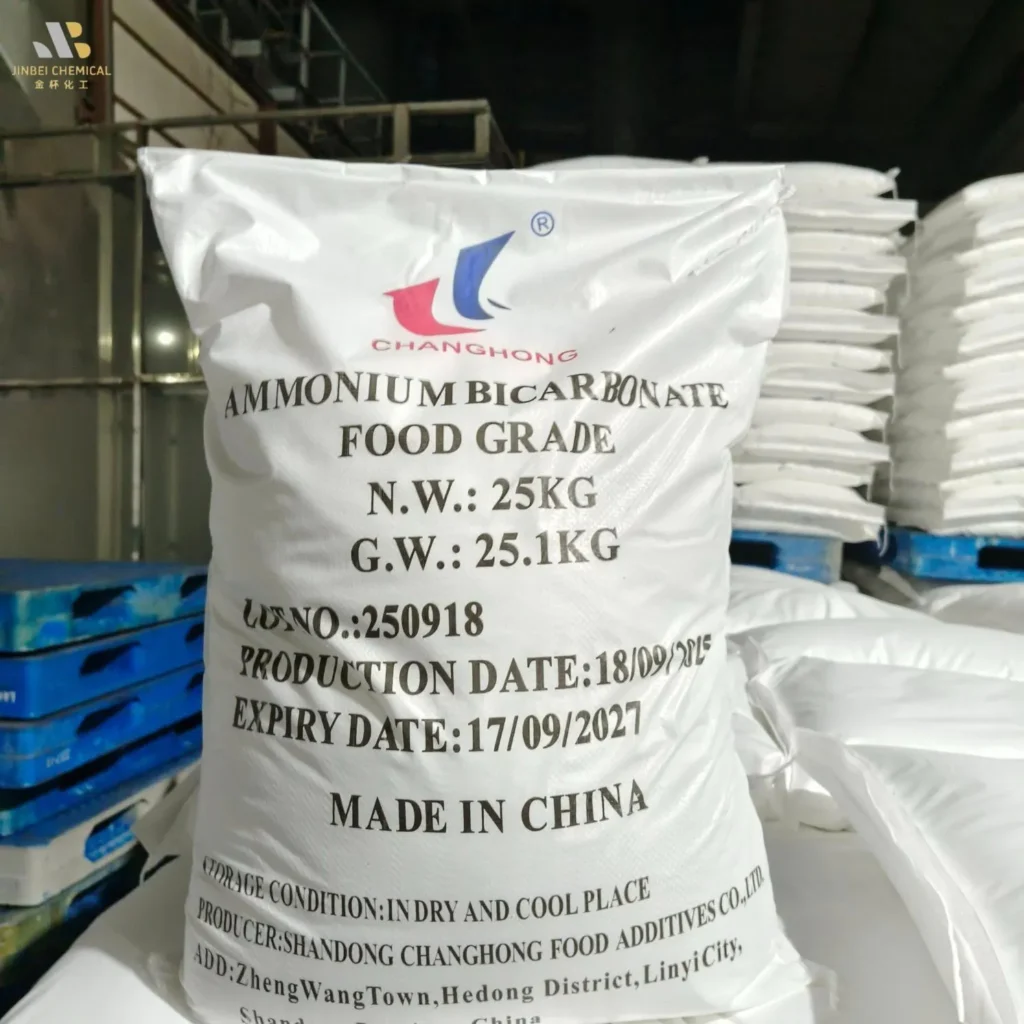
| Labelling | Food Additive: Ammonium Bicarbonate + SC number | “Agricultural use/Industrial use” |
| Permitted in food | Yes | No — illegal regardless of nitrogen content |
The decisive test is conceptual rather than numerical: food-grade ammonium bicarbonate must prove what does not volatilise. Chloride, sulfate, heavy metals and ash are exactly the things that stay behind in your cracker after baking. A fertiliser COA reports nitrogen — a number that tells you nothing about those residues. If a supplier answers your chloride question with an N% figure, end the conversation.
Four failure modes (and which number predicts each)
1. Ammonia odour in the finished product. This is a thickness-and-moisture problem. Ammonia must diffuse out during baking; in products thicker than roughly 5–8 mm, or with high final moisture, a fraction gets trapped and re-dissolves in the moist crumb during cooling. Fix: restrict ammonium bicarbonate to thin, low-moisture items; reduce dosage; increase bake-out (more time rather than more peak temperature); or replace part of it with sodium bicarbonate/SAPP so the gas profile shifts from ammonia-driven to CO₂-driven.
2. Weak rise / inconsistent volume between batches. Ammonium bicarbonate loses potency simply by sitting warm. Because it starts decomposing near room temperature and is highly hygroscopic, a bag stored at 30 °C for a month is genuinely weaker than a fresh one — and a standard titration may still read “acceptable” because it measures total ammonium, not available gas. Fix: buy in quantities matched to your consumption rate, store below 20 °C in sealed original packaging, first-in-first-out strictly, and validate each lot with a bench bake test (measure spread/density) rather than relying on assay alone. This is the one leavener where a functional lot test beats a chemical one.
3. Yellowing or alkaline aftertaste — wait, that’s not this product. Correct. This is the cleanest differentiator versus sodium bicarbonate: ammonium bicarbonate leaves no alkaline residue, so it cannot cause the yellowing/soapy taste that excess sodium carbonate produces. If your spec sheet shows yellowing, look at the sodium bicarbonate portion of your leavening system, not the ammonium bicarbonate.
4. Caking, lumping and bag swelling. Normal for this material if temperature fluctuates: partial decomposition followed by recrystallisation cements particles together; released ammonia swells sealed bags. Caking does not necessarily mean lost potency, but lumps destroy dosing accuracy in volumetric feeders. Fix: do not break lumps by hand and return fines to the hopper — sieve gently, record lot numbers, and never top up a partially used bag from a different lot.
Choosing the leavener by product geometry
| Product | Ammonium bicarbonate role | Typical usage | Notes |
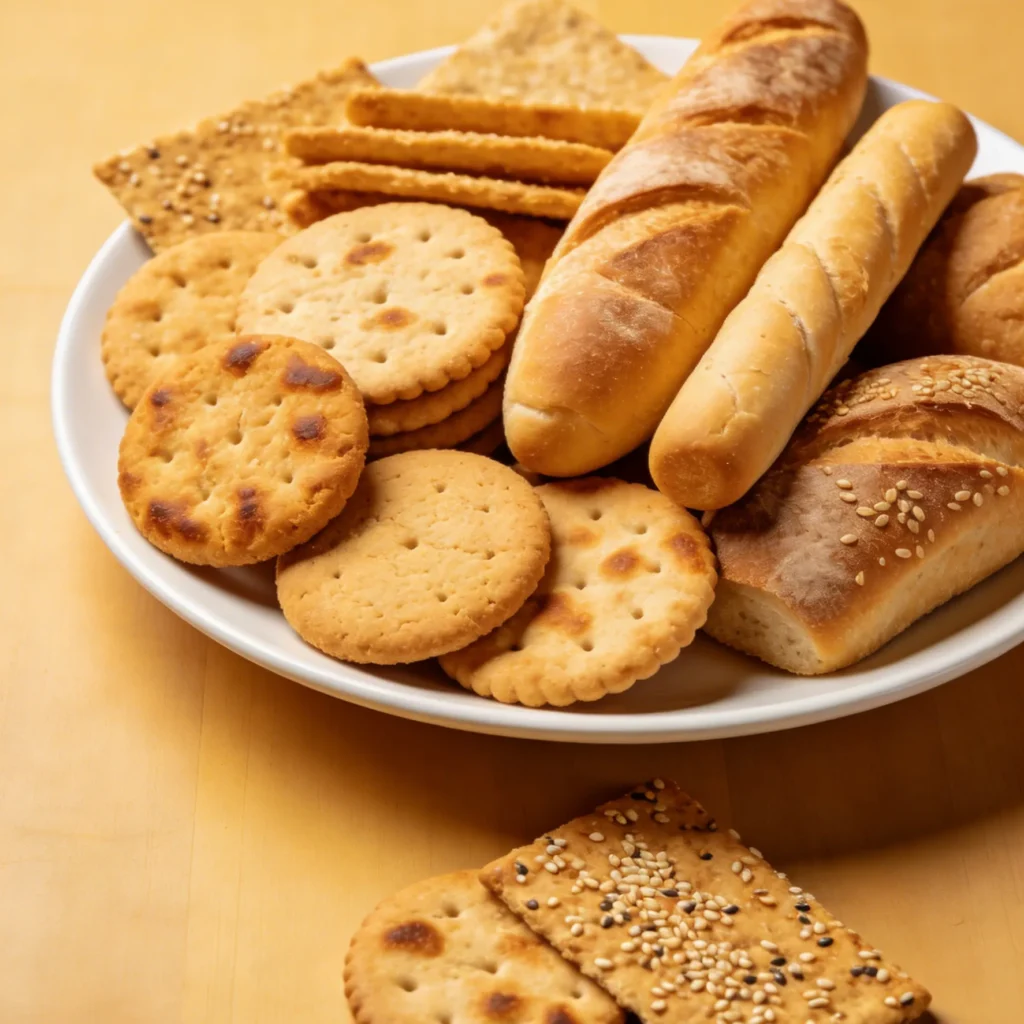
| Crackers, soda crackers | Primary leavener | 0.3–1.0% on flour | Classic use: thin, dry, fully baked-out → no residual odour |
| Wafers | Primary/part | 0.2–0.8% on flour | Cell structure and crispness; no residue avoids film build-up on plates |
| Cream puffs / choux | Part of blend | 0.1–0.4% | Boosts oven spring; keep total ammonia low enough to avoid odour in the hollow |
| Cookies (thin, low-moisture) | Part of blend | 0.2–0.6% | Works in snap-type; avoid in soft/chewy cookies |
| Flatbreads, crispbreads, matzah | Primary | 0.3–1.0% | High bake-out, ideal fit |
| Traditional fried doughs (youtiao etc.) | Traditional leavener | Per traditional formula | Often combined; watch oil absorption and odour |
| Thick cookies, cakes, muffins | Avoid or minimise | — | Geometry prevents ammonia escape → odour defect |
| Moist fillings, icings, dairy | Not applicable | — | No bake-out stage = guaranteed off-odour |
| Non-food: flue-gas desulfurisation, pharma intermediate, feed, fire extinguisher | Separate grade | — | Grade follows use; never cross-use batch numbers |
Ranges are industry-common intervals. Validate against your own pilot trials and target-market regulations.
How to choose an ammonium bicarbonate manufacturer (the checklist buyers actually use)
Because this material is produced both as food additive and as fertiliser in very large volumes, the supplier-selection step carries more risk than with most ingredients. A workable filter:
1. Licence first. Ask for the SC certificate covering food additives and confirm the product name on the licence matches “Ammonium bicarbonate”. Fertiliser producers can be perfectly competent chemically and still have no legal basis to sell into food.
2. Grade segregation on site. One plant making both grades is acceptable only if there is physical separation of lines, silos, bags and labelling, plus dedicated dispatch documentation. Ask for photos and the most recent third-party audit report. Shared silos are how cross-contamination incidents happen.
3. COA content beyond nitrogen. Require chloride, sulfate, heavy metals (Pb/As), residue on ignition and loss/drying, plus batch number traceability. A COA that only reports NH₄HCO₃%/N% is a fertiliser document.
4. Packaging and odour control. Multi-layer moisture-proof bags with inner liner; check whether the supplier offers small-lot packs for low-consumption lines. Bag integrity after warehouse storage is a good proxy for their moisture control.
5. Capacity and seasonality. Ammonium bicarbonate demand is seasonal in agriculture; food-grade allocation can tighten when fertiliser season peaks. Lock in contract volumes and lead times in writing, and keep a second qualified source.
6. Certificates by claim. Halal/Kosher/non-GMO/allergen statements must be confirmed before ordering; these cannot be back-dated.
7. Price sanity check. If a quote sits materially below the food-grade market, assume it is fertiliser-grade relabelled until proven otherwise — and insist on a pre-shipment sample plus a third-party report at your cost. The saving is never worth the recall.
Storage & handling: store cool (ideally ≤20 °C), dry and sealed, away from acids, oxidants and strong heat; protect from rain and condensation; keep away from open containers in the same room as finished goods because ammonia migrates into fats and powders. Typical shelf life 12 months subject to enterprise standard — and always re-validate by bench bake after long storage.
Compliance & labelling points
- In China, ammonium bicarbonate is a food additive (leavening agent), used per GB 2760 category list with GMP-type usage; label must carry the additive designation and SC details.
- EU: E503(ii); declare in ingredients. Note that “ammonium carbonate” and “ammonium bicarbonate” are distinct E-number entries — declare accurately.
- US: permitted as leavening agent; label as “ammonium bicarbonate”.
- Sodium-free positioning: because it contributes zero sodium, it is the preferred crisping leavener where sodium reduction is a claim driver. This is its genuine structural advantage over sodium bicarbonate. Bear in mind the overall formulation sodium, not just the leavener.
- Allergen/GMO: inherently free; PKU warning not applicable.
- Odour management in the plant: ammonia release is real at scale. Ensure local exhaust at the dosing point and keep it away from chocolate, dairy powders and flavour stores — fat absorbs ammonia and holds the odour.
Figures above are indicative ranges from public standards and literature. Confirm final acceptance criteria against the current valid standard text and your batch COA before release.
FAQ
Q1: Can I replace sodium bicarbonate entirely with ammonium bicarbonate?
Not usually. Ammonium bicarbonate gives fast, early gas and no residue but no neutralising action and poor performance in thick or moist products. The robust approach is a blend: ammonium bicarbonate for early lift and crispness, sodium bicarbonate plus an acid leavener (e.g. SAPP) for structure and pH balance.
Q2: My crackers smell faintly of ammonia after cooling. Is the raw material bad?
Rarely. It is almost always insufficient bake-out or excessive dose for the product thickness. Check the moisture profile through the band, extend baking time slightly, reduce the ammonium bicarbonate by 10–20%, and run a side-by-side panel test before touching the supplier.
Q3: Does it work in no-sodium or low-sodium claims?
Yes — this is its strongest use case. It contributes lift and crispness with zero sodium. Just verify the claim against total formulation sodium including all other ingredients.
Q4: Is the strong ammonia smell on opening the bag a defect?
A slight ammonia odour is normal for this material. A violently pungent smell with swollen, hard-caked bags indicates heat exposure and partial decomposition — quarantine the lot, run a bench bake test for potency, and request a replacement COA.

Q5: Does it need to be food grade?
Yes, for any food use. Fertiliser-grade Ammonium bicarbonate is cheaper and widely available, which is precisely why auditors check the SC licence and the label wording first.
Q6: Are you a manufacturer?
We supply food grade ammonium bicarbonate (E503(ii)) with per-batch COA covering chloride, sulfate, heavy metals and residue on ignition, SC qualification and third-party reports; 25 kg moisture-proof bags and bulk options; Halal/Kosher/non-GMO on request. We also quote compound blends tailored to cracker/wafer lines and can arrange mill-direct programmes for volume buyers.
See our guide on why industrial and food grades must not be substituted.
Need specs, samples or a quote?
Contact us for the specification sheet, per-batch COA and samples of ammonium bicarbonate / baker’s ammonia — including lot validation by bench bake, pack-size options matched to your consumption rate and custom leavening blends.
Food Grade Sodium Bicarbonate: Specifications and Dosage
Liquid Glucose: DE Selection and Failure Modes